
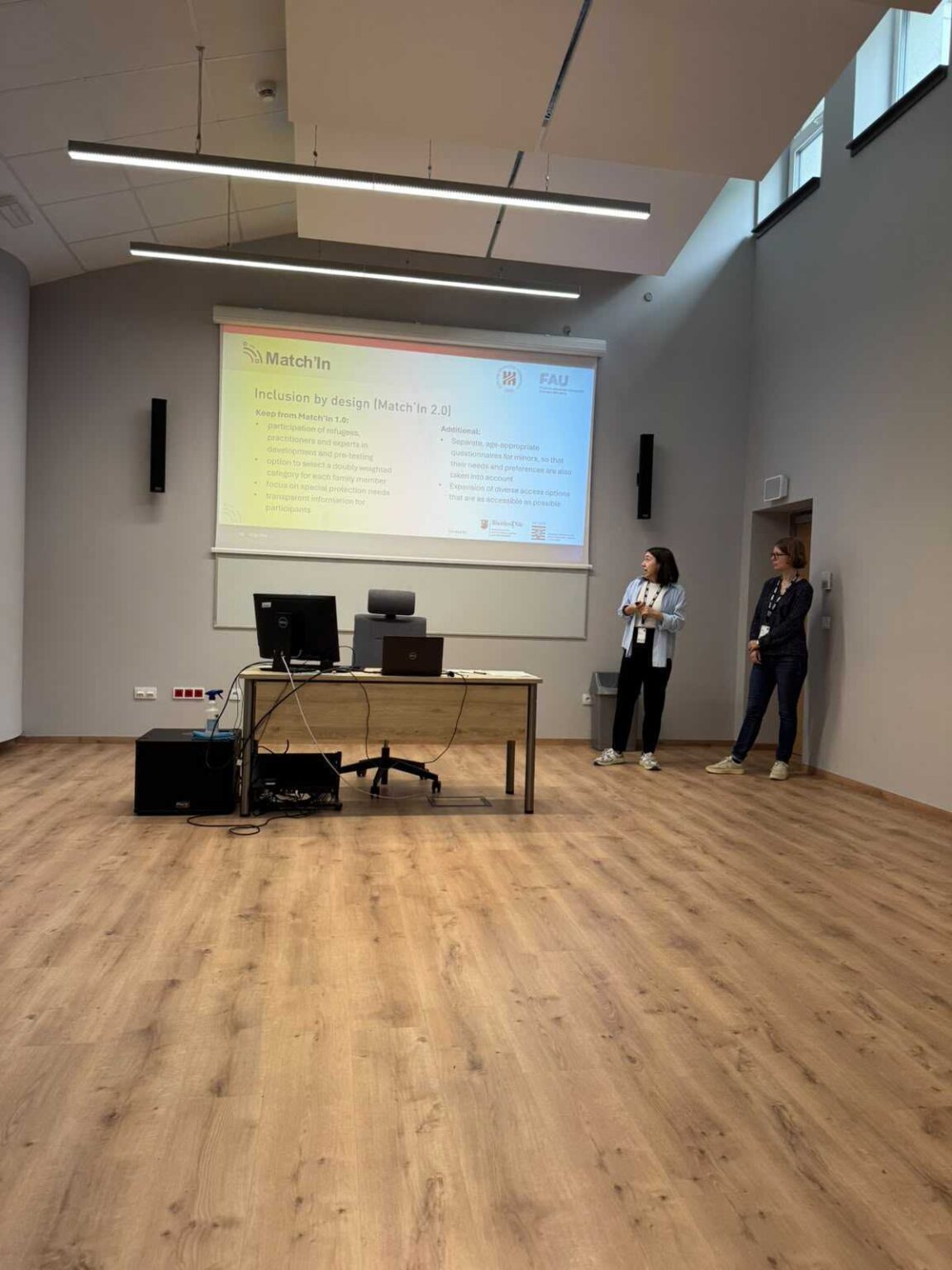
As part of a panel titled “Governing Migration Digitally: Inclusion, Accountability, or New Inequalities?”, we introduced the project Match’In and its previous phases (Katharina Euler and Anna Werning) as well as the algorithms functioning during the Match’In-procedure (Christian Sauer) in two presentations. This was supplemented with Sonja Reinhold’s presentation on human-rights-sensitive design of digital applications, using the Match’In-procedure as an example.
A discussion followed, in which we addressed critical questions and helpful comments added by the panel participants. This started with reiterating the integration of the Match’In-procedure into the regular allocation system of the respective federal state. Consequently, the existing quota regulations regarding the distribution of refugees still apply. However, the Match’In-procedure also takes the individual characteristics of the municipalities and those seeking protection into account and prioritizes special vulnerabilities and needs. The quotas can be exceeded or undercut on short notice during this process.
This was followed by the question regarding to what extend far-right incidents in municipalities are factored into the placement suggestions of the Match’In-procedure. Until now, far-right incidents in municipalities have not been considered in the Match’In-procedure, as even municipalities where such incidents occurred remain obligated to accept refugees. Nevertheless, the question points to a difficult ethical dilemma regarding the project: On one hand, it is necessary to consider the possible consequences of distributing asylum seekers to municipalities where far-right incidents have taken place. On the other hand, it is also important to prevent municipalities where far-right sentiments prevail from receiving fewer allocations. In the worst-case scenario, this could serve as an incentive for further acts of far-right violence in order to prevent such allocations. Furthermore, a database that records and categorises such incidents does not exist. In the process of allocating placements, the project therefore currently takes infrastructure such as counselling services and participation schemes at the level of municipalities, and specific protection needs at the individual level into account.
Finally, participants were also interested in how the system prevents those seeking protection and the municipalities from using the Match’In-procedure strategically to secure a specific allocation proposal. Considering the multitude of criteria factored into the matching, it can be assumed that this possibility does not exist for either the municipalities or those seeking protection. The municipalities’ profiles only include information relating to the specific local situation and do not specify their own preferences regarding the characteristics of the people to be taken in. Furthermore, a lot of the required information is publicly available and has already been researched in advance by the project team. This is primarily intended to relieve the municipalities, yet it simultaneously prevents them from giving inaccurate answers to self-assessment questions based on strategic considerations. Those seeking protection are moreover specifically encouraged to state their preferences in the Match’In-procedure, as this can increase their satisfaction with and acceptance of the placement decision and facilitates opportunities for local participation long-term.
Overall, attending the ECPR conference was more than worthwhile, and the project team gained valuable insights for their continous work on the Match’In-procedure!
We have also compiled information on the questions raised during the panel discussion and further ones regarding the Match’In process in our FAQ (only available in German).
Photo: Sonja Reinhold