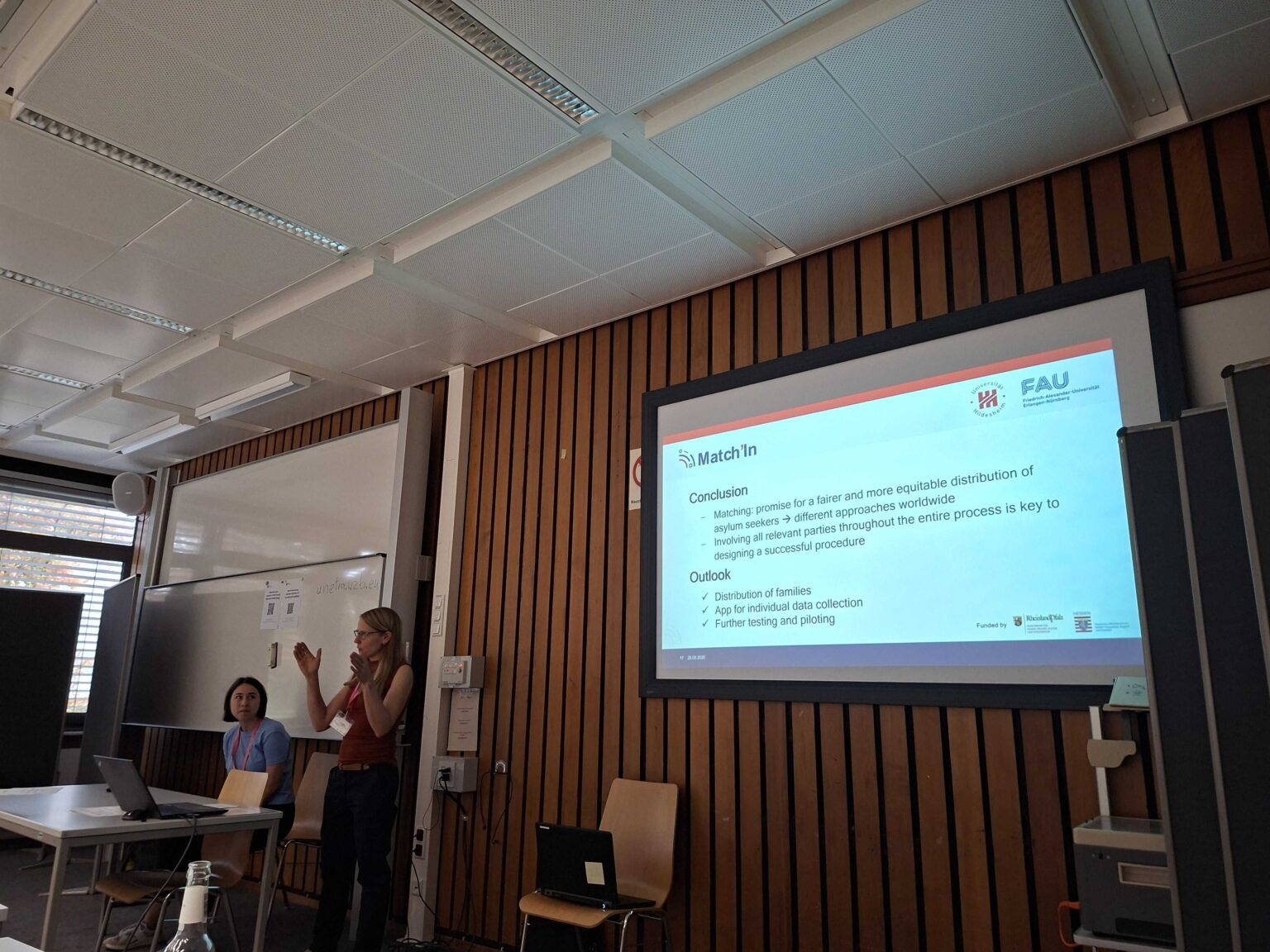
During the panel ‘Refugee Dispersal Policies: Balancing Administrative Efficiency, Spatial Justice and Individual Rights’, the team once again presented the Match’In project to an international audience of experts. The subsequent round of questions included discussions on, amongst other things, the evaluation of the first project phase and the integration of Match’In into the regular system.
The presentation of the Match’In project as a practice-oriented initative joined a wider discussion on various practices regarding the distribution of refugees within the EU: Further contributions to the panel came from Walter Bartl (Martin Luther University Halle-Wittenberg), who presented a comparative study together with Philipp Lutz (University of Geneva/University of Amsterdam), which examines the distribution practices of various EU Member States. Jonas Wiedner presented the findings of a meta-study about the effects of location onto the integration of refugees, and Marta Pachocka (SGH Warsaw School of Economics/University of Warsaw) provided an insight into various, sometimes unintended, distribution practices in Poland and their effects.
Furthermore, Deniz Nergiz from the Match’In team took part in a round-table on the role of forced migration studies in times of desolidarization. Together with Judith Vey (University of Bremen), Lisa Johnson (Research Centre for Migration, Integration, Asylum), Hannes Schammann (University of Hildesheim) and Annette Korntheuer (Munich University of Applied Sciences), she discussed which forms of engagement are possible in forced migration studies, whether they are necessary or even problematic, and what opportunities, risks and pitfalls come with engaged scholarship.
These questions are particularly relevant to Match’In: as a practice-oriented research project, the initiative operates at the interface between academia, public administration and practice, and is thereby faced with the question of how academic findings can be translated into concrete changes.
Photo: Katharina Euler